Today I participated in the 2nd webinar School for Synodality via Zoom, alongside around thirty other participants, exploring the core theme “Together on the Road”.
Synod – Together on the Road
- Journey of life as a pilgrimage
- The Pilgrim People of God walking together (Vatican 2: Lumen Gentium)
- A walking together towards the Father
- Listening together for the guiding movement of the Spirit
Walking together – with similarities and differences
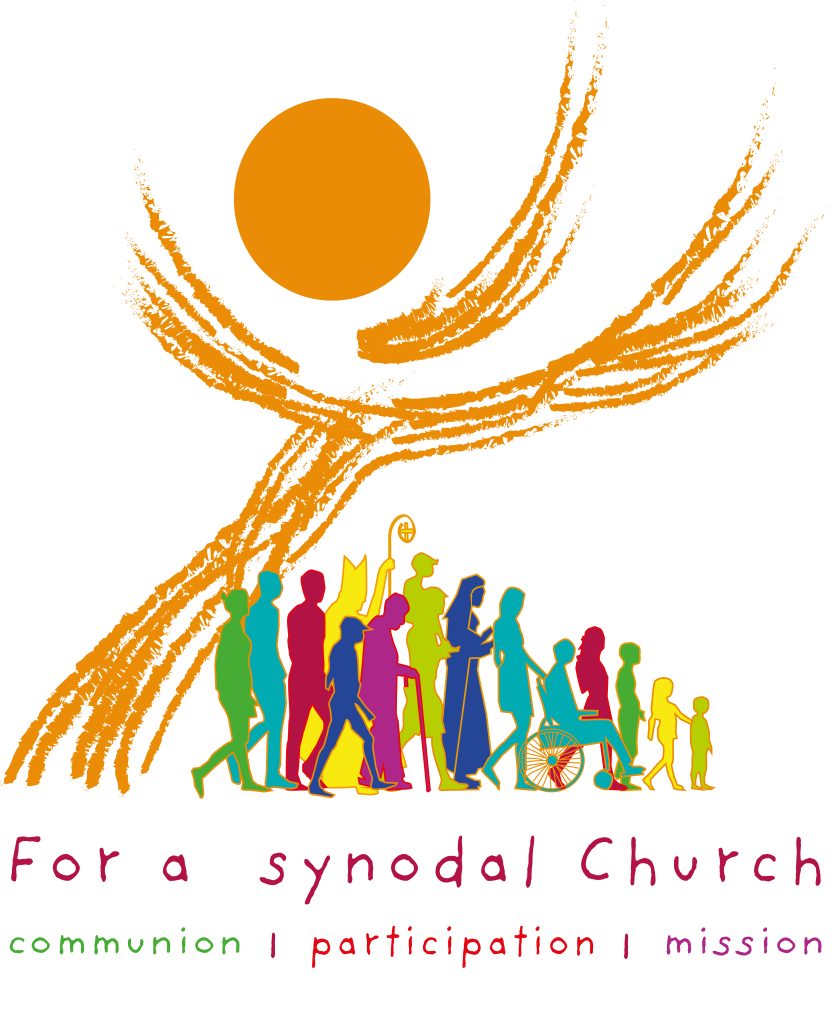
- Logo for Synod on Synodality reminds us that we are all different (unique) –
we don’t look the same, think the same, we’re not from the same place or have the same language, different ages, sexes, culture, backgrounds,
experiences, perspectives, etc – but all on the same road and heading in the same direction (at different speeds) - We’re not all in the same place on that road: some are pulling ahead, leading the way, others towards the back
- The child at the front is a reminder that sometimes it can be the smallest, the most insignificant who can hold the key for showing us the next step along the road
- As the journey continues perhaps there is a swapping around in positions –some who were towards the back now find themselves more towards the front
- We see things differently
- Is the face looking to one side or out of the page?

- Is it a 9 or a 6? – depends on where you are standing

A very different way of being together
‘Synodality depends on courage both in speaking and in listening. It is not about engaging in a debate where one speaker tries to get the better of the others or counters their positions with clever arguments, but about expressing whatever seems to have been suggested by the Holy Spirit as useful, at the same time being open to accepting whatever has been suggested by the same Spirit in other people’s positions, “for the general good” (1 Corinthians 12, 7)’
Synodality in the life and mission of the Church, International Theological Commission
- Synodality invites the holding of difference without tension – sees difference not as a problem but rather a source for the uncovering of some deeper journey
- Not about the loudest voice dominating
- Not a parliamentary (democratic) system where the majority ‘wins’
Something different is needed: Discernment
Discernment is a slow uncovering of God’s will that gradually moves us from where we are now to where God wants us to be.
Discernment is the way to live in the midst of a changing world. It has to be
communal, for no single person can control everything, and God does not allow himself to be captivated by anyone.
Common Apostolic Discernment – Adolfo Nicholas SJ Discernment requires:
- Prayerful openness – creating space to listen to God and to be attentive to the movement of the Holy Spirit.
- Freedom – being willing to let go, at least provisionally, of our preferred
outcome or the need to be in control. - Honesty – acknowledging what we genuinely think and feel, including hopes, fears, attachments and resistance.
- Listening – listening deeply to God, to one another and to the reality we are actually facing, rather than simply waiting for our turn to speak.
- Patience – resisting the pressure to reach a quick conclusion; allowing things to emerge and become clearer over time.
- Attention to the movements within us – noticing what brings consolation, desolation, peace, anxiety, energy, defensiveness or freedom, without immediately assuming that any one feeling is God’s answer.
- Willingness to be changed – allowing what we hear and discern to challenge our assumptions and alter our position.
- Attention to the whole – holding together different perspectives, experiences and voices, especially those that are less easily heard.
- Testing and confirmation – discerning individually and together, and looking for confirmation rather than relying on a single impression or moment.
- Courage to act – recognising that discernment is ultimately directed towards faithful action, not simply achieving greater clarity.
Discernment asks something of us: the freedom to let go of our preferred outcome, the honesty to name what is really going on, the attentiveness to listen to God, to
one another and to ourselves, and the openness to allow the Spirit to lead us somewhere we might not have chosen ourselves.
Leo XIV Homily at the Jubilee of Synodal Teams and Participatory Bodies 26 October 2025
The supreme rule in the Church is love. No one is called to dominate;
all are called to serve. No one should impose his or her own ideas; we must all listen to one another.
No one is excluded;
we are all called to participate.
No one possesses the whole truth;
we must all humbly seek it
and seek it together.
Being a synodal Church means recognising that truth is not possessed, but sought together, allowing ourselves to be guided by a restless heart in love with Love.
Leo XIV Homily at the Jubilee of Synodal Teams and Participatory Bodies 26 October 2025