Battles. Fireworks. A chance for the bass to shine.
THE BASS HAS SOMETHING TO SAY
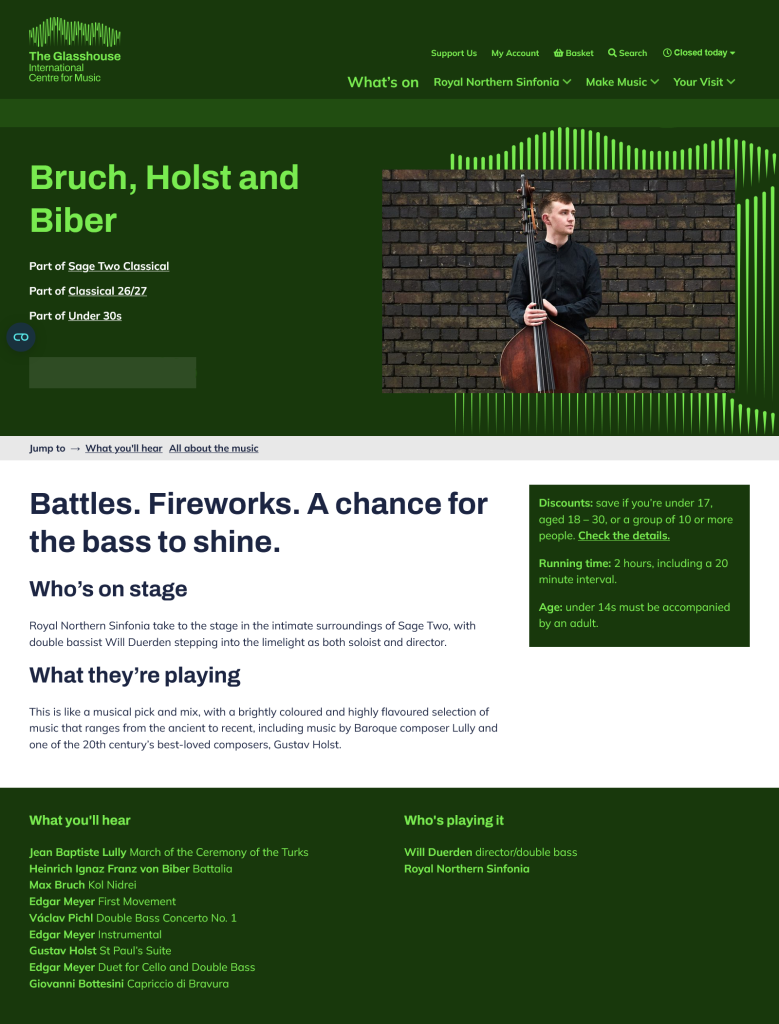
Will Duerden, Pichl, Bottesini and Edgar Meyer
At the heart of this concert was Will Duerden, a young double bassist whose developing international career demonstrates how far perceptions of the instrument have changed. Duerden was a winner at the Young Classical Artists Trust Live Final Auditions in 2023, was nominated as a Classic FM Rising Star for 2024, and became a Borletti-Buitoni Fellowship artist in the same year. In 2026 he was selected as a Bowers Program artist for 2027–30 by the Chamber Music Society of Lincoln Center in New York City. His appearances have taken him across Britain, continental Europe and Australia, while his chamber-music collaborators have included Lawrence Power, Steven Isserlis, Thomas Adès and Daniel Lebhardt, among others.
At The Glasshouse, however, it was the instrument itself that became the story. Václav Pichl’s Double Bass Concerto No. 1 returned us to the eighteenth-century Classical world. Born in Bohemia in 1741, Pichl belonged to the cosmopolitan musical culture of Central Europe. His concerto was written for the historical Viennese tuning associated with the remarkable flourishing of virtuoso double-bass playing during the eighteenth century. Rather than the modern tuning of the instrument in fourths, this system arranged the strings differently, helping to make resonant chords, arpeggios and agile solo passages particularly effective. That historical detail helps explain something immediately apparent in Pichl’s concerto: the double bass can be stately, lyrical, agile and brilliant. An instrument normally experienced as part of the orchestra’s foundation is brought decisively into the foreground. Pichl reverses the familiar relationship. The supporting voice becomes the principal voice. With Duerden standing before the orchestra, bringing this eighteenth-century writing vividly into the present, the point became wonderfully clear:
the bass does not merely support somebody else’s melody. It possesses a voice of its own.
Lully provided the swaggering entrance before Biber transformed the string orchestra into soldiers in Battalia, eventually allowing the excitement and disorder of battle to give way to a lament for the wounded. Bruch took us somewhere entirely different. A Protestant Christian responded to the sacred melodies of Judaism, while music originally written for cello acquired extraordinary gravity through the deeper voice of Duerden’s double bass. The instrument continued to change before our ears.
Pichl gave it Classical elegance. Bottesini gave it astonishing nineteenth-century virtuosity. Edgar Meyer brought it decisively into the contemporary world, where the bass could converse as an equal with other instruments. Finally Holst returned us to the string orchestra as a community of individual voices and reminded us of another form of musical inheritance: the teacher passing music to another generation. Seen together, these apparently different compositions seemed to share an invitation to reconsider what we thought we already understood.
About an instrument.
About another culture.
About another religion.
Even about the relationship between music and war.
For one evening at The Glasshouse, the bass moved from the back of our consciousness to the centre of our attention.
Sometimes it swaggered.
Sometimes it fought.
Sometimes it danced.
Sometimes it conversed.
Sometimes it flew.
And in Bruch’s Kol Nidrei, in the hands of Will Duerden, it seemed almost to pray. Perhaps that is what I shall remember most about this remarkable concert.
Sometimes the voice we most need to hear is the one we have not been listening to.