Why did Leo leave words out of the Creed in Turkey? (Watch)
ANDREAS SOLARO | ANDREAS SOLARO


Aleteia – published on 11/30/25
By praying a historical version of the Creed all could agree on, the Pope and the Christian leaders placed unity above divisions.
2025 CHRISTMAS CAMPAIGN
Help Aleteia continue its mission by making a tax-deductible donation.
In this way, Aleteia’s future will be yours as well.
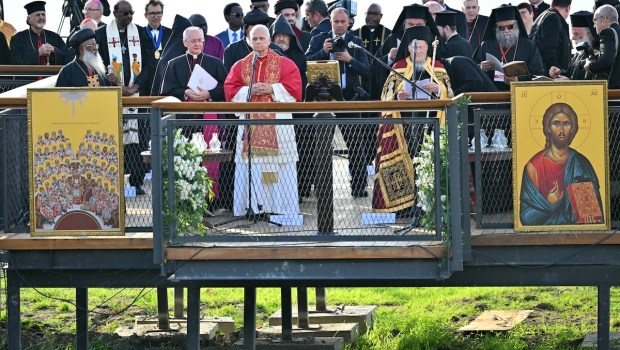
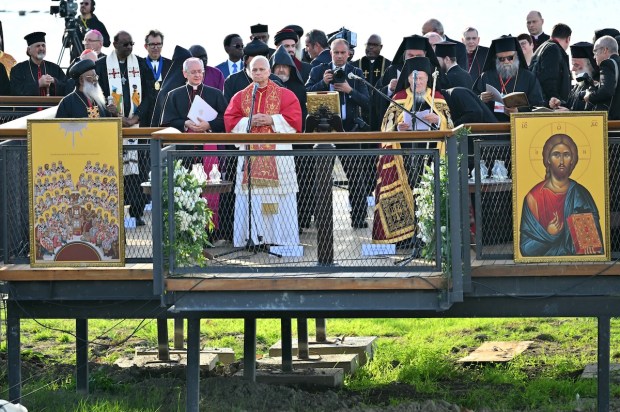
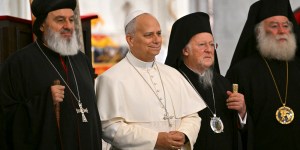
Pope Leo XIV visited Iznik (where Nicaea once stood) in Turkey on November 28 to commemorate, with some 20 Christian leaders, the 1,700th anniversary of the Council of Nicaea. Standing before the ruins of a once-submerged ancient basilica, they proclaimed together the Creed, Christianity’s first profession of faith. The version they used did not include the words “and [from] the Son” – in Latin, “Filioque.”
“Remembering the first ecumenical council”
This commemoration is an event of great significance “because it’s about remembering the first ecumenical council,” explains Archbishop Job Getcha, Metropolitan of Pisidia, whose seat is in Antalya. “Nicaea defined the foundations of the Christian faith. It’s the first council that Orthodox and Catholics share. It’s also recognized by the Churches that emerged from the Reformation.“
In front of the ruins of an ancient submerged basilica, Christian leaders recited the Creed, the first Christian confession.
To preserve unity, the version they prayed was the original Nicene-Constantinopolitan text, which does not include the words “and [from] the Son,” familiar to Catholics and Protestants but foreign to the Orthodox.
Indeed, unlike the Orthodox, Catholics profess that the Holy Spirit, the third person of the Trinity, proceeds from God the Father “and the Son,” “Filioque” in Latin. This expression was added after the Councils of Nicaea and Constantinople, and was never adopted by the Orthodox.
This wasn’t the first time that the Bishop of Rome has omitted these words in an ecumenical context. In September 2025, for example, Leo XIV pronounced this Creed without the “Filioque” during an ecumenical celebration in the Basilica of St. Paul Outside the Walls.
A theological divergence
The “Filioque” is at the heart of the theological discord between Eastern and Western Christianity. This Latin expression meaning “and from the Son” was added to the Nicene-Constantinopolitan Creed by the Western Church. Some theologians believe that this insertion took place in 447 at a synod in Toledo. However, the most widely accepted opinion is that it took place in 589, during the Third Council of Toledo.
While the Eastern Churches professed that the Holy Spirit “proceeds from the Father,” the West gradually inserted the words “and from the Son,” pointing to a theological divergence.
This difference, initially doctrinal, became a political issue. In 1014, under pressure from the Holy Roman Emperor Henry II, Pope Benedict VIII officially incorporated the “Filioque” into the Creed. This divide crystallized over the centuries, fueling the “Filioque Controversy,” which the Orthodox still cite as one of the main causes of the break with Rome in 1054.
Today, it remains a symbol of a disagreement over the nature of the Trinity and authority in the Church, a persistent wound between Catholics and Orthodox Christians.
While this single word (in Latin) can be seen as a significant issue and a point of contention, both Leo and Bartholomew spoke of the event at Iznik as historic and consequential, and theologians repeatedly confirm that what unites the Orthodox and Catholic Churches is far and away more than the small issues that divide them.
Read also :Pope writes on 1,700th anniversary of Nicene Creed
The text of the Creed
Here is the text of the Creed used on November 28, as found in the event booklet (PDF):
We believe in one God,
the Father, the Almighty,
maker of heaven and earth,
of all that is, seen and unseen.
We believe in one Lord, Jesus Christ,
the only Son of God,
eternally begotten of the Father.
Light from Light,
true God from true God,
begotten, not made;
of one Being with the Father.
Through him all things were made.
For us all, and for our salvation
he came down from heaven;
and was incarnate
of the Holy Spirit and the virgin Mary,
and was made human.
For our sake he was crucified
under Pontius Pilate;
he suffered and was buried.
On the third day
he rose from the dead
in accordance with the scriptures.
He ascended to heaven
and is seated at the right hand of the Father.
He will come again in glory
to judge the living and the dead
and his kingdom will have no end.
We believe in the Holy Spirit,
the Lord, the giver of life,
who proceeds from the Father.
Who, with the Father and the Son,
is worshipped and glorified,
who has spoken through the Prophets.
We believe in one, holy,
catholic and apostolic Church.
We confess one baptism
for the forgiveness of sins.
We look forward to the resurrection of the dead,
and to life in the age to come. Amen.
The Christian world is still divided
The photo of Christian representatives gathered in Nicaea illustrated the state of Christian disunity, a world still divided. Notably, the meeting was marked by the absence of part of Orthodoxy. The Patriarchate of Constantinople chose to invite only Orthodox Churches established in the first millennium. The Patriarchate of Moscow, which broke communion with Constantinople, was not present.
This commemoration therefore symbolized both efforts towards unity and the rifts that have been exacerbated since Russia’s invasion of Ukraine, which was blessed by the Patriarchate of Moscow.
Read also :Pope concludes Turkey trip with 2 moments of Orthodox prayer
Read also :Pope proposes 2033 as next goal for Christian unity work
Support Aleteia’s mission with your donation