Edition
English


Sunday 11 January |
Feast of the Baptism of the Lord
Aleteia Premium
Pope Leo outlines hopes for gathering of cardinals
© Vatican Media

Kathleen N. Hattrup – published on 01/07/26
From four possible themes, the cardinals chose two to focus on during this first meeting.
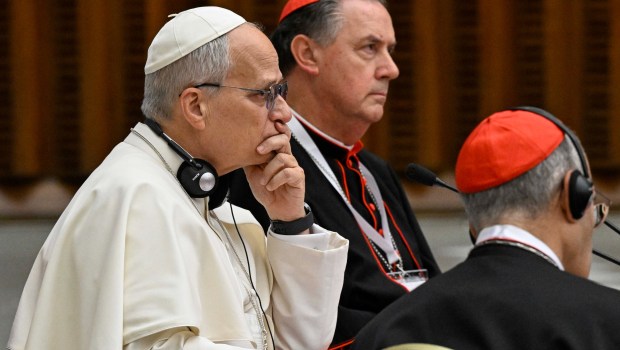
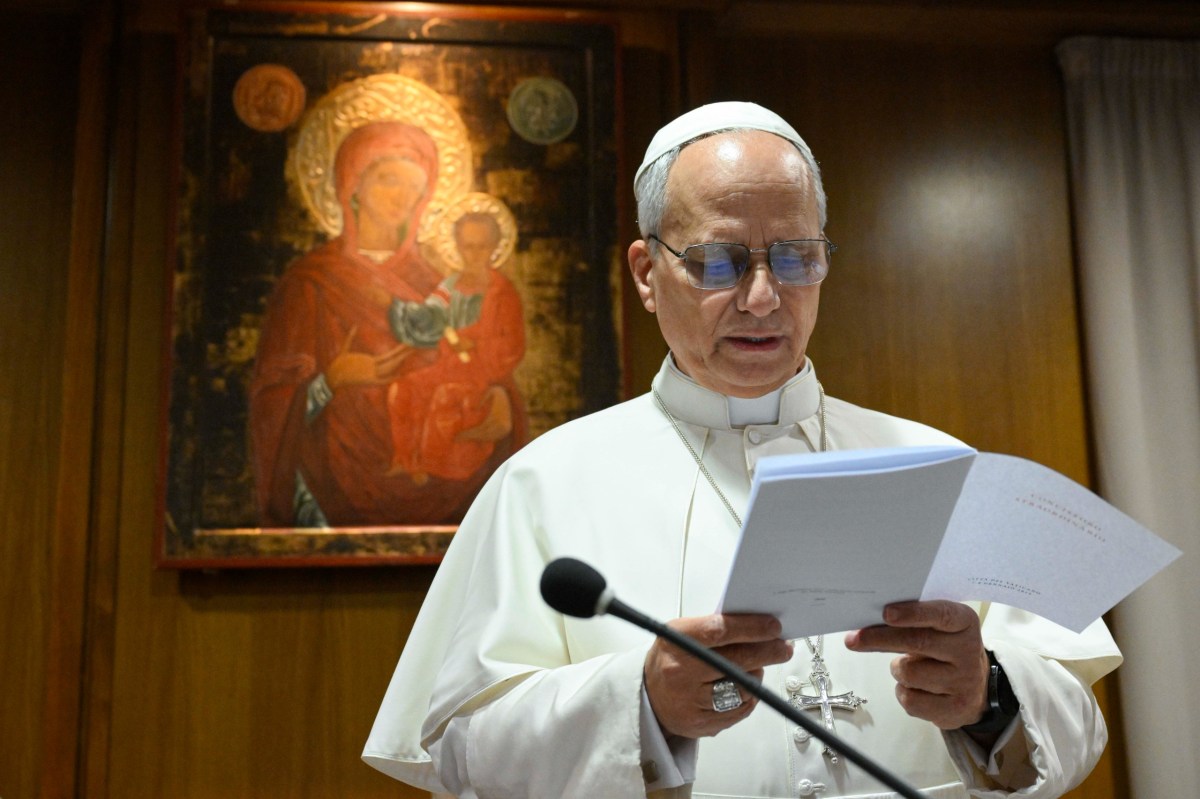
While the “extraordinary consistory” — gathering some 170 cardinals of the 245 living cardinals of the whole world — is being held behind closed doors, the Vatican released this afternoon an opening address the Pope gave and offered some details about how the event is taking place.
In his address, Leo explains that four possible themes are on the agenda, but that due to time constraints, they would only discuss two.
He began by drawing a parallel between a text from the liturgy of Epiphany (celebrated yesterday) and a text of Vatican II, and then focusing on a quote from Benedict XVI.
During the first afternoon, participants listened to a meditation by British Cardinal Timothy Radcliffe, who was also one of the voices at the two global sessions of the Synod on Synodality in 2023 and 2024. He urged, in particular, that the Successor of Peter not be left alone “as he faces the storms of the world.”
“The Church itself is shaken by its own storms: sexual abuse and ideological divisions,” he emphasized.
Then the cardinals divided in 20 groups around round tables in Paul VI Hall, as the members of the Synod had done. Nine groups consisted of cardinal-electors from Churches around the world, and 11 represented cardinals of the Curia or non-elector cardinals over the age of 80. As of Monday, the group of non-electors outnumbers the electors.
Themes chosen
The members of the groups, led by a designated chairperson and secretary, could speak in turn for three minutes, the director of the Holy See Press Office, Matteo Bruni, explained at a briefing at the end of the day.
Each group was invited to choose two themes from the four announced in the letter of convocation: the mission of the Church in today’s world; the service of the Holy See to the particular Churches; the Synod and synodality; and the liturgy.
The “vast majority” of them voted for the themes of mission and synodality, Bruni indicated.
At the end of the session, the Pope met with the cardinals in the Paul VI Hall and addressed them to thank them for their participation. “The time is very short, but it is important, also for me,” he told them.
Regarding the chosen themes, Leo XIV emphasized that they should not be seen as opposing one another because some “overlap.” He encouraged the cardinals to “experience newness in the Church” through listening to the Word of God.
“There may be doubts, fears […] but if we place our trust in the Lord and in his presence, we can do great things,” he assured them.
Here is the full translation of his address and a photo gallery:
~
Dear Brothers,
I am very pleased to welcome all of you. Thank you for your presence! May the Holy Spirit, whom we have invoked, guide us during these two days of reflection and dialogue.
I consider it highly significant that we have gathered in Consistory on the day after the Solemnity of the Epiphany of the Lord, and I would like to introduce our work by proposing something drawn precisely from this mystery.
The liturgy echoed the ever-moving appeal of the prophet Isaiah: “Arise, shine; for your light has come, and the glory of the Lord has risen upon you. For darkness shall cover the earth, and thick darkness the peoples; but the Lord will arise upon you, and his glory will appear over you. Nations shall come to your light, and kings to the brightness of your dawn” (Is60:1-3).
These words call to mind the beginning of the Second Vatican Council’s Constitution on the Church. I will read the first paragraph in its entirety: “Christ is the light of the nations and consequently this holy Synod, gathered together in the Holy Spirit, ardently desires to bring all humanity that light of Christ which is resplendent on the face of the Church, by proclaiming his Gospel to every creature (cf.Mk16:15). Since the Church, in Christ, is a sacrament — a sign and instrument, that is, of communion with God and of the unity of the entire human race — it here proposes, for the benefit of the faithful and of the entire world, to describe more clearly, and in the tradition laid down by earlier councils, its own nature and universal mission. The present situation lends greater urgency to this duty of the Church, so that all people, who nowadays are drawn ever more closely together by social, technical and cultural bonds, may achieve full unity in Christ” (Lumen Gentium, 1).
While centuries apart, we can say that the Holy Spirit inspired the same vision in the prophet and in the Council Fathers, namely the vision of the light of the Lord illuminating the holy city — first Jerusalem, then the Church. The guidance of this light enables all peoples to walk in the midst of the darkness of the world. What Isaiah announced figuratively, the Council recognizes in the fully revealed reality of Christ, the light of the nations.
We can understand the overall pontificates of Saint Paul VI and Saint John Paul II within this conciliar perspective, which sees the mystery of the Church as entirely held within the mystery of Christ, and thus understands the evangelizing mission as a radiation of the inexhaustible energy released by the central event of salvation history.
Popes Benedict XVI and Francis, in turn, summarized this vision in one word: “attraction.” Pope Benedict referred to this in his homily for the opening of the Aparecida Conference in 2007, when he said: “The Church does not engage in proselytism. Instead, she grows by ‘attraction’: just as Christ ‘draws all to himself’ by the power of his love, culminating in the sacrifice of the Cross, so the Church fulfils her mission to the extent that, in union with Christ, she accomplishes every one of her works in spiritual and practical imitation of the love of her Lord.” Pope Francis was in perfect agreement with this, and repeated it several times in different contexts.
Today, I joyfully revisit this theme and share it with you. I invite us to pay close attention to what Pope Benedict signaled as the “power” that drives this movement of attraction. Indeed, this power isCharis, it isAgape, it is the love of God that became incarnate in Jesus Christ and that, in the Holy Spirit, is given to the Church, sanctifying all her actions. Furthermore, it is not the Church that attracts, but Christ; and if a Christian or an ecclesial community attracts, it is because through that “channel” flows the lifeblood of Charity that cascades from the Heart of the Savior. Moreover, it is significant that Pope Francis began withEvangelii Gaudium“on the proclamation of the Gospel in today’s world,” and concluded withDilexit Nos“on the human and divine love of the Heart of Jesus Christ.”
Saint Paul writes, “the love of Christ urges us on” (2 Cor5:14). The verbsunecheisignifies that the love of Christ urges us on because it possesses us, envelops us and captivates us. This is the power that attracts everyone to Christ, as he himself foretold: “And I, when I am lifted up from the earth, will draw all people to myself” (Jn12:32). To the extent that we love one anotheras Christ has loved us, we belong to him, we are his community, and he can continue to draw others to himself through us. In fact, only love is credible; only love is trustworthy. [1]
While unity attracts, division scatters. It seems to me that physics also confirms this, both on the microscopic and macroscopic levels. Therefore, in order to be a truly missionary Church, one that is capable of witnessing to the attractive power of Christ’s love, we must first of all put into practice his commandment, the only one he gave us after washing his disciples’ feet: “Just as I have loved you, you also should love one another.” He then adds: “By this everyone will know that you are my disciples, if you have love for one another” (Jn13:34-35). Saint Augustine observes: “This is why he loved us, so that we too might love one another. By loving us, he gave us the help we need to bind ourselves together in mutual love, and, bound together by such a pleasing bond, we are the body of such a mighty Head” (Homily 65 on the Gospel of John,2).
Dear Brothers, I would like to begin here, with these words of the Lord, for our first Consistory and especially for the collegial journey that, with God’s grace, we are called to undertake. We are a very diverse group, enriched by a wide range of backgrounds, cultures, ecclesial and social traditions, formative and academic paths, pastoral experiences, not to mention personal characteristics and traits. We are called first to get to know one another and to dialogue, so that we may work together in serving the Church. I hope that we can grow in communion and thus offer a model of collegiality.
Today, in a certain sense, we will continue that memorable meeting, which I was able to share with many of you immediately after the Conclave, in “a moment of communion and fraternity, of reflection and sharing, aimed at supporting and advising the Pope in the demanding responsibility of governing the universal Church” (Letter Convoking the Extraordinary Consistory, 12 December 2025).
In the coming days, we will have the opportunity to engage in a communal reflection on four themes: Evangelii Gaudium, that is, the mission of the Church in today’s world; Praedicate Evangelium, namely the service of the Holy See, especially to the particular Churches; the Synod and synodality as both an instrument and a style of cooperation; and the liturgy, the source and summit of the Christian life. Due to time constraints, and in order to encourage a genuinely in-depth analysis, only two of them will be discussed specifically.
While each of the twenty-one groups will contribute to the choice that we will make, the groups that will be reporting will be those nine coming from the local Churches, since it is naturally easier for me to seek counsel from those who work in the Curia and live in Rome.
I am here to listen. As we learned during the two Assemblies of the Synod of Bishops of 2023 and 2024, the synodal dynamic implies a listeningpar excellance. Every moment of this kind is an opportunity to deepen our shared appreciation for synodality. “The world in which we live, and which we are called to love and serve, even with its contradictions, demands that the Church strengthen cooperation in all areas of her mission. It is precisely this path of synodality which God expects of the Church of the third millennium” (Francis, Address on the Fiftieth Anniversary of the Institution of the Synod of Bishops, 17 October 2015).
This day and a half together will point the way for our path ahead. We must not arrive at a text, but continue a conversation that will help me in serving the mission of the entire Church.
Tomorrow, we will discuss the two chosen themes, with the following question as a guide:
Looking at the path of the next one or two years, what considerations and priorities could guide the action of the Holy Father and of the Curia regarding each theme?
This will be our way of proceeding: being attentive to the heart, mind and spirit of each; listening to one other; expressing only the main point and in a succinct manner, so that all can speak. The ancient Romans in their wisdom used to say: Non multa sed multum! In future, this way of listening to each other, seeking the guidance of the Holy Spirit and walking together, will continue to be a great help for the Petrine ministry entrusted to me. Even the way in which we learn to work together, with fraternity and sincere friendship, can give rise to something new, something that brings both the present and the future into focus.
May the Holy Spirit always guide us, and may the Virgin Mary, Mother of the Church, assist us.
______________
Read also :What exactly is the “extraordinary consistory” starting today?
[1] Cf. H.U. Von Balthasar,Glaubhaft ist nur Liebe, Johannes Verlag, Einsiedeln 1963.
Do you celebrate your baptism anniversary?
Pixabay
Yes
No
633 participants
Did you enjoy this article? Would you like to read more like this?
Get Aleteia delivered to your inbox. It’s free!Terms and Conditions
Tags:
Comment
You must be logged in to comment.
If you don’t already have an Aleteia account, create a free one now! An account gives you access to all Aleteia articles and the opportunity to comment.
Already a member?

Bill
2026-01-08 10:59
the article was wonderful. the pop-ups were very, very distracting
Newsletter
Get Aleteia delivered to your inbox. It’s free!Terms and Conditions
Top 10
Indiana QB Fernando Mendoza: ‘All the glory to God’2Pope Leo: Surrogacy is a violation of dignity3Why many baptismal fonts have eight sides4Route announced for 2026 Eucharistic Pilgrimage5Indiana QB Fernando Mendoza reveals his pre-game routine: prayer6These monks give a French twist to Italian limoncello7How to discover your patron saint for 2026
Daily prayer
© Copyright Aleteia SAS all rights reserved.
Powered byWordPress.com VIP
