Become one of our guardian angels
Edition
English


Monday 29 December |
Aleteia Premium
How the Creed refuses to let Christianity forget history

Antonio Ciseri | PD

Daniel Esparza – published on 12/27/25
Christianity does not begin with an idea but with a child, and it does not end with a concept but with an empty sepulcher — into history.
2025 CHRISTMAS CAMPAIGN
Help Aleteia continue its mission by making a tax-deductible donation.
In this way, Aleteia’s future will be yours as well.
At an academic meeting years ago, a group of professors was asked what was non-negotiable in a Christian humanism–inspired curriculum. The answer came quickly and almost unanimously: the articles of the Nicene Creed. Listening to them, I found myself thinking something slightly different. Not the articles, exactly — the narrative. From manger to empty sepulcher. From story, not theory.
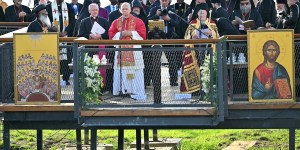
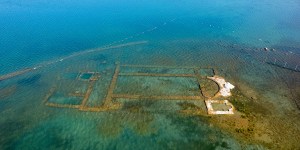
That instinct helps explain why Pope Leo XIV’s recent recitation of the Creed before the ruins of an ancient basilica in Turkey mattered so much. The Pope was not delivering a lecture on doctrine amid archaeological remains. He was speaking a story in a place where history presses against the present. Stone, dust, and sky formed the backdrop for words that refuse, or at least resist, abstraction.
The Nicene Creed can look, at first glance, like compressed theology: “begotten,” “consubstantial,” “incarnate.” But its decisive move is, I think, also narrative. It follows the arc Christians know from the Gospels themselves. Creation gives way to incarnation. Birth leads to suffering. Death opens onto resurrection. And then comes the line that anchors everything: Christ “suffered under Pontius Pilate.”
Pilate matters. He is not a symbol, nor a theological concept. He is a Roman governor with a historical footprint. His name appears in the Creed for the same reason it appears in the Gospels: to insist that this story happened somewhere, sometime, under a recognizable political authority. The Creed refuses to let Christianity drift into myth. It plants belief firmly in the soil of history.
This is where the Creed mirrors the biblical narrative — it does not replace it. The Gospels are not abstract meditations on salvation; they are stories full of names, places, meals, betrayals, fear, friendships, and love. Bethlehem, Nazareth, Jerusalem. A manger. A trial. A cross. An empty tomb. The Creed distills that narrative without abandoning it. Even when it sounds conceptual, it carries what might be called a historical horizon — one that opens fully the moment Pilate enters the sentence.
The historian Marc Bloch saw this clearly. “The Greeks and Latins, our first teachers, were people who were writers of history. Christianity is a religion of historians.”
Christianity depends on memory, testimony, and transmission. It survives because it can be told again, checked against time, and handed on without dissolving into ideology.
That insight connects naturally to Augustine, whose Confessions is often read as interior spirituality but is, in fact, a narrative act. Augustine tells his life as a story shaped by grace moving through time. Identity emerges through memory honestly faced. Pope Leo XIV, an Augustinian, clearly grasps that faith weakens when it forgets how deeply it depends on storytelling grounded in real events — and real locations.
In the Christmas season, this becomes urgent. The Nativity is not a seasonal image but a historical claim: God enters the world through birth, vulnerability, and place. Christianity does not begin with an idea but with a child, and it does not end with a concept but with an empty sepulcher — into history.
Support Aleteia’s mission with your donationhttps://donorbox.org/embed/jaime-linfo-project-aleteia?amount=60
Read also :Why did Leo leave words out of the Creed in Turkey? (Watch)
Read also :What the ruins of Nicaea teach us today

Read also :Astronomers on what the Nativity Proclamation tells us
Did you enjoy this article? Would you like to read more like this?
Get Aleteia delivered to your inbox. It’s free!Terms and Conditions
Tags:
Enjoying your time on Aleteia?
Articles like these are sponsored free for every Catholic through the support of generous readers just like you. Please make a tax-deductible donation today!
Help us continue to bring the Gospel to people everywhere through uplifting Catholic news, stories, spirituality, and more.
Make a tax-deductible donation!!
You must be logged in to comment.
If you don’t already have an Aleteia account, create a free one now! An account gives you access to all Aleteia articles and the opportunity to comment.
Already a member?
Newsletter
Get Aleteia delivered to your inbox. It’s free!Terms and Conditions
Top 10
The gift that moved Mark Wahlberg this Christmas2Challenges and blessings at the globe’s most northern parish3Where did the Holy Family live in Egypt?4Why is a can of sardines among the treasures of the Vatican?5Feeling lonely? Quick — find your ‘3rd place!’6Perhaps you need to change your thinking on the Holy Family7What trips might be in store for Leo XIV in 2026?
Daily prayer
Suggested Prayer of the Faithful
© Copyright Aleteia SAS all rights reserved.
Powered byWordPress.com VIP
